
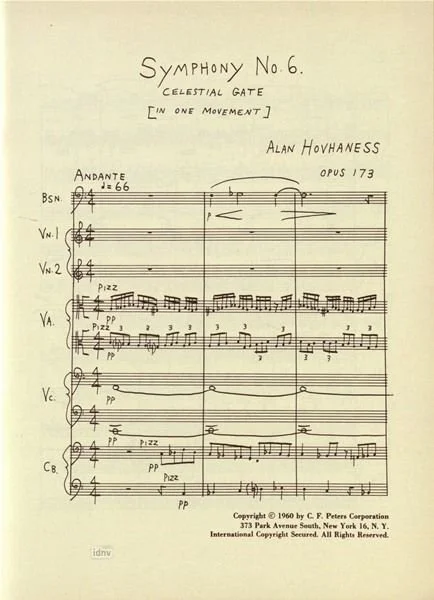
Hovhaness - Symphony No. 6
Composed in 1972, Alan Hovhaness’s Sixth Symphony, subtitled Celestial Gate, reflects the composer’s lifelong fascination with spirituality, nature, and the musical traditions of the East. Rather than emphasizing dramatic conflict, Hovhaness creates a contemplative sound world in which serene melodies, rich orchestral colors, and meditative textures unfold with a sense of timelessness. The symphony’s title evokes a passage between the earthly and the transcendent, and the music often feels like a journey toward a place of peace and illumination. Gentle chorales, flowing counterpoint, and moments of radiant grandeur are woven together in a style that is unmistakably Hovhaness—deeply personal yet universally accessible. Celestial Gate invites listeners to step away from everyday concerns and enter a realm of reflection, wonder, and spiritual tranquility. It stands as one of Hovhaness’s most evocative expressions of his belief in music as a pathway to the sublime.
Mansurian - Romance
Sargis Karapetyan, solo violin
Armenian composer Tigran Mansurian is renowned for music of extraordinary restraint, clarity, and emotional depth. In Romance, he distills profound feeling into a simple, intimate musical language, allowing each phrase to unfold with quiet inevitability. Drawing on the lyricism of Armenian musical traditions while speaking in a distinctly contemporary voice, Mansurian creates a work that is both deeply personal and universally expressive. The music sings with gentle melancholy and tenderness, favoring subtle nuance over dramatic display. Moments of silence and stillness are as important as the notes themselves, inviting listeners into a space of reflection. Elegant and understated, Romance exemplifies Mansurian’s unique ability to convey powerful emotions through economy of means, revealing beauty in simplicity and quiet contemplation.

Sargis Karapetyan holds a Master's Degree and Artist Diploma in Violin Performance from the Komitas State Conservatory in Yerevan, Armenia. Mr. Karapetyan has been the Director of Pedagogy Courses and a lecturer at the String Instrument Department of the Conservatory. He also was the Artistic Director of Ancient Music Ensemble and the concertmaster of the Children's Opera Theater. Mr. Karapetyan has worked as an assistant concertmaster of “Gelikon” Opera Theater and the “Competition Winners” chamber Orchestra in Moscow, Russia. Mr. Karapetyan has worked with many New England orchestras, including Rhode Island Philharmonic, Granite State Opera, Granite State Symphony, and Nashua Symphony Orchestra of NH. Mr. Karapetyan is a former faculty member at the Boston Conservatory and Clark University. As a recitalist he has performed throughout New England, Virginia and Pennsylvania.
Mizoryan - Symphony for Strings and Timpani
Armenian composer Edvard Mirzoyan was one of the leading musical voices of twentieth-century Armenia, blending lyrical warmth with dramatic intensity. His Symphony for Strings and Timpani, composed in 1962, is among his most significant orchestral works and remains a cornerstone of the Armenian string orchestra repertoire. Scored for string orchestra and a prominent timpani part, the symphony creates a striking dialogue between singing, expressive melodies and powerful rhythmic declarations. Mirzoyan’s music combines the formal clarity of the European symphonic tradition with echoes of Armenian folk song, producing a sound world that is both deeply personal and universally compelling. Moving from moments of introspection and sorrow to passages of determination and triumph, the work unfolds with a sense of emotional honesty and dramatic purpose. Richly expressive yet tightly constructed, the Symphony for Strings and Timpani stands as a powerful testament to Mirzoyan’s unique artistic voice and his enduring contribution to Armenian music.